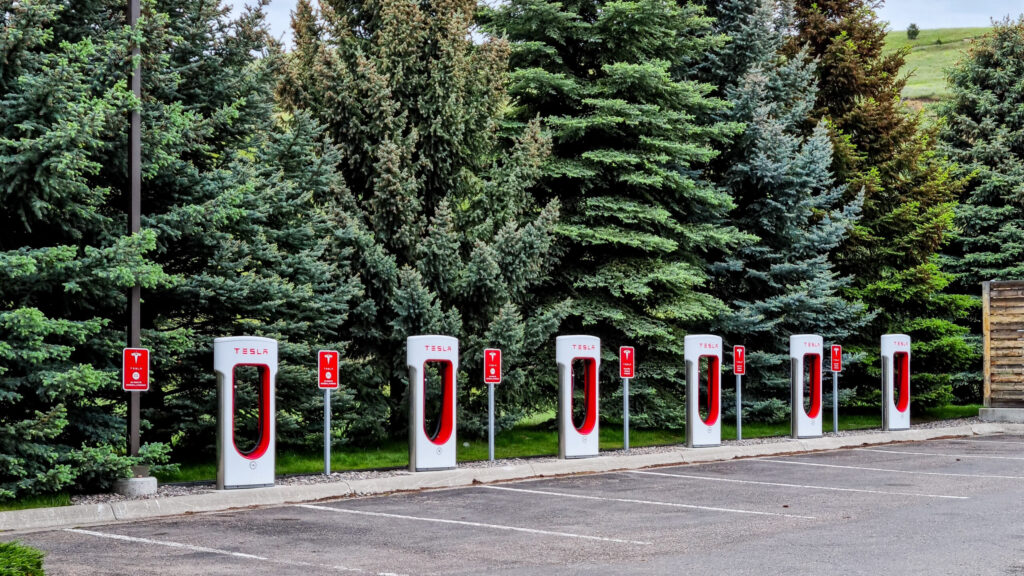

Tesla is now building chargers for one of its biggest rivals. EVgo has opened its first Tesla Supercharger site, a 12-stall station in Chicago, and says hundreds more are on the way. The EVgo Supercharger deal marks a turning point for electric car charging in the United States: the company that built the most popular fast-charging network is now selling its hardware to the competition.
The first site opened on November 5 at Riverside Square & River’s Edge, 3145 South Ashland Avenue in Chicago, next to a Mariano’s grocery store on property owned by Regency Centers. The stalls carry EVgo branding, but the hardware, software and upkeep come from Tesla, through its Supercharger for Business program. Charging runs at 25 to 35 cents per kilowatt-hour, and both Tesla and non-Tesla cars can plug in without an adapter, thanks to Tesla’s Magic Dock connector, which supports both NACS and CCS plugs. Each stall delivers up to 325 kilowatts, while the V4 hardware behind it is rated to 500 kilowatts.
Tesla’s charging lead is slipping
The deal comes as Tesla’s grip on fast charging loosens. Its share of United States fast-charging ports has fallen from 54.3% to 49.3% in a year, below half for the first time, even though Tesla added 5,700 plugs, according to ThinkEV. Rivals collectively grew their networks nearly twice as fast. In J.D. Power’s 2026 charging study, the Ionna consortium scored 807 out of 1,000, pushing Tesla to fourth place behind Mercedes-Benz’s network and Rivian’s Adventure Network. Selling hardware to EVgo lets Tesla earn revenue from a rival’s expansion while EVgo takes on the property and upkeep costs.
What it means for drivers
For drivers, the change is practical: more fast chargers, in more places, that work with more cars. EVgo says its first wave of Supercharger sites will go up at grocery-anchored Regency properties, putting fast charging where drivers already shop, and it plans to add 500 NACS-enabled stalls across its network by the end of 2026. As global EV sales keep climbing, the charging map is being redrawn, and Tesla’s share of the US EV market is no longer the only number that matters. The plug has won; now the hardware business is up for grabs.