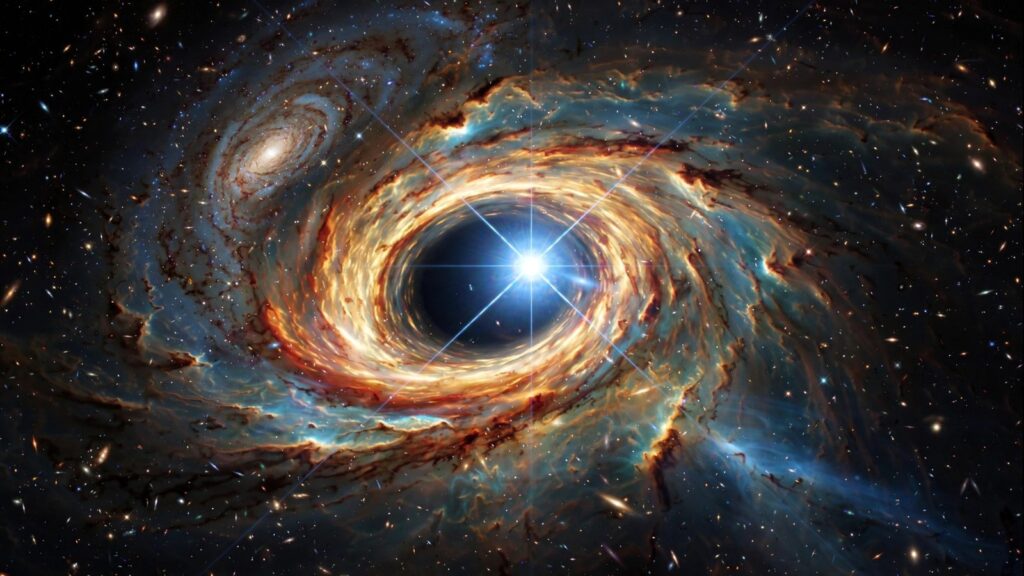

Astronomers have found the first statistical evidence that some supermassive black holes are kicked out of the centers of their galaxies — a stunning vindication of a prediction made a decade ago. By analyzing data on around 100,000 quasars, researchers at Hungary’s Eötvös Loránd University (ELTE) detected the telltale signature of recoiling black holes, according to a study published in the Monthly Notices of the Royal Astronomical Society.
The relationship now identified in the data was predicted ten years ago by members of the same research group — Peter Raffai and Zsolt Frei, together with Zoltán Haiman. The present study was led by Bence Bécsy, who graduated from ELTE and now works at the University of Birmingham.
How a Black Hole Gets Kicked
At the center of every large galaxy lies a supermassive black hole millions or billions of times the Sun’s mass. When two galaxies merge, their central black holes spiral together, emit gravitational waves and eventually merge. If those waves are not emitted equally in all directions, the remaining black hole receives a powerful “kick” — like the recoil of a gun — reaching velocities of several million kilometers per hour.
“It is very difficult to prove that the black hole in a single quasar has been ejected, because other phenomena can produce similar signatures,” lead author Bécsy said. “What is new about our research is that, rather than looking for individual candidates, we searched statistically for traces of an entire population.”
What It Means for the LISA Observatory
If the signal is indeed caused by ejected black holes, then two supermassive black holes merged relatively recently in a significant proportion of quasars — meaning such events are common. “This directly determines how many such events LISA may be able to detect,” said Professor Frei, head of the HUN-REN–ELTE Extragalactic Astrophysics Research Group.
LISA, the European Space Agency’s space-based gravitational wave observatory planned for launch in 2035, could provide the definitive answer. The authors caution that alternative explanations — winds, viewing angles or other effects — have not been completely ruled out, leaving the final verdict to future observations.