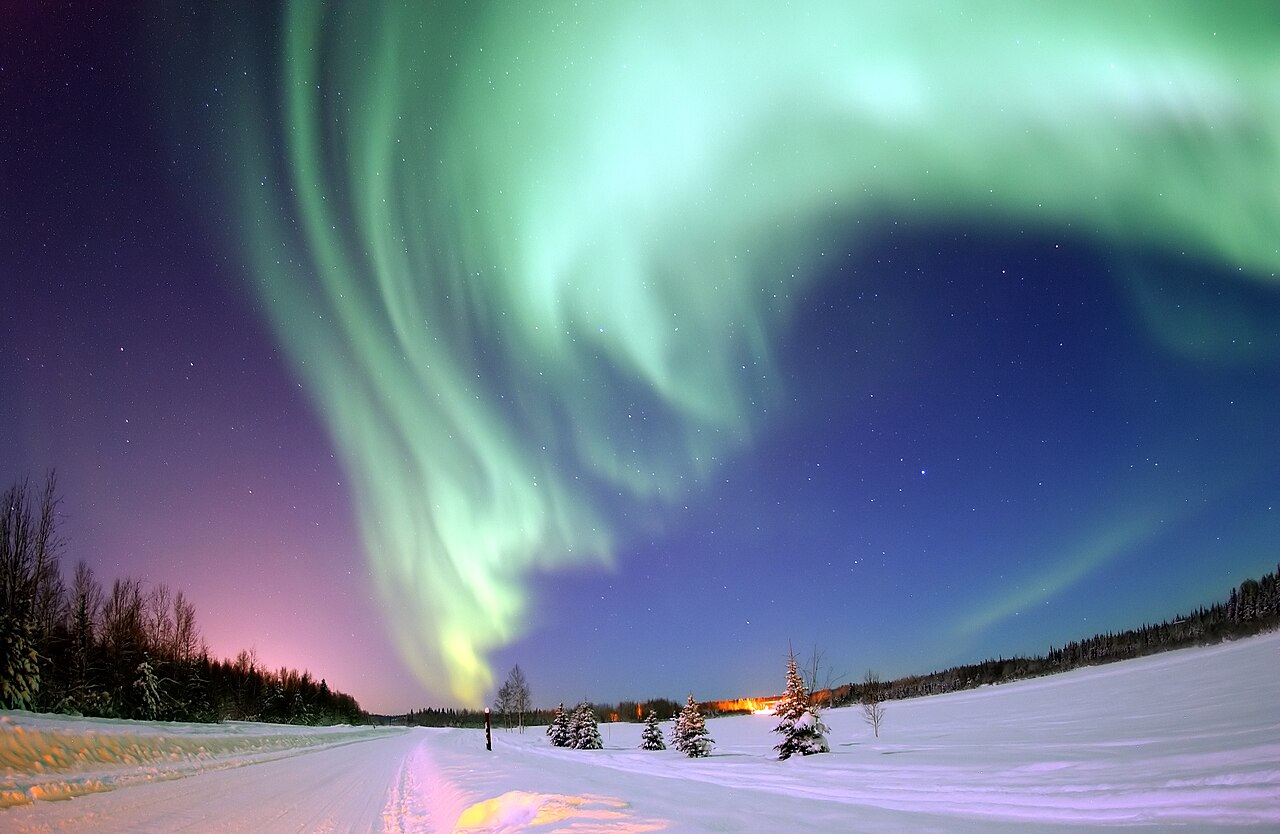
A giant, L-shaped hole on the Sun is facing Earth, sending a fast stream of solar wind our way — and forecasters say the Northern Lights could reach as far south as New York this weekend.
The hole is a coronal hole, a gap in the Sun’s outer atmosphere where the solar wind escapes faster than usual. NOAA’s Space Weather Prediction Center issued a G1 (minor) geomagnetic storm watch for 6–8 November at 17:45 UTC on 5 November, with G2 (moderate) possible on 7–8 November, and effects that could last through the weekend to 9 November. The UK Met Office forecast solar wind speeds of 550 to 650 kilometres per second, with the stream arriving around 6 November and persisting through 9 November.
How far south?
Under a G1 storm, the aurora is visible from northern Michigan, Maine, northern Scotland and Scandinavia. Under G2, it could extend to New York and Idaho. That is the forecast — and it matters to say so, because at the time of reporting the auroras were forecast and likely, not confirmed sightings. NOAA reported at 12:05 UTC on 7 November that no space-weather storms had been observed in the past 24 hours, with the greatest three-hour Kp index at 3, and G1 likely from 7 to 9 November. The Australian Space Weather Forecasting Centre reported G1 at planetary level on 7 November, and G2 in the Antarctic region.
Solar activity around the same time included an M3.5 flare from active region AR4566, peaking at 18:33 UTC on 5 November, with a coronal mass ejection that initial analysis said was not Earth-directed, and 29 C-class flares in the 24 hours to 7 November, the strongest a C5.9 from AR4566 at 00:53 UTC on 7 November. A glancing blow from a 1 November coronal mass ejection may add to the mix.
Look up, if the sky cooperates
Coronal holes, not flares, are driving this storm — the distinction matters, because a hole delivers a steady fast wind rather than a single blast. If the G2 level is reached, the lights could be visible far further south than usual. If it stays at G1, the show stays in the north. Either way, the weekend is the window: a giant hole, a fast wind, and a sky worth watching after dark.