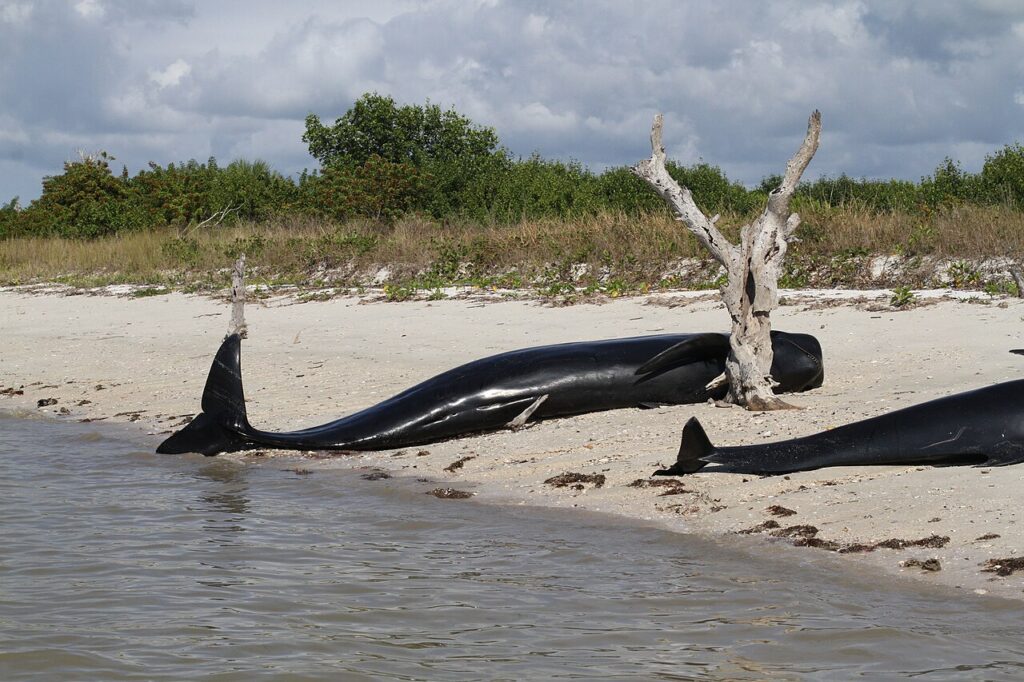


Pilot whales stranded on a remote New Zealand beach have given rescuers a small glimmer of hope, with two whales successfully refloated and four more still alive as teams race against the tide at Cape Palliser.
The stranding was first reported on Thursday 5 November, when dozens of pilot whales were found along the Ngawi coast near Cape Palliser, the southernmost point of New Zealand’s North Island. Locals told Radio New Zealand that up to 50 whales may have come ashore overnight.
Two whales back in the water
New Zealand’s Department of Conservation said at least 20 pilot whales were stranded on the beach, and it was working with local iwi and Project Jonah, a group that specialises in rescuing stranded whales. Two whales have been successfully refloated so far, according to the department.
In a post on Facebook on Thursday, Project Jonah said four whales were alive and rescuers would try to refloat them during high tide. Volunteers have been keeping the survivors alive and hydrated using buckets of water and towels while they wait for the next favourable tide.
Why strandings happen
The cause of this stranding is unknown, the department said. Pilot whales are highly social animals that travel in large pods, and when one animal strands, others can follow it ashore. Scientists will collect tissue samples from the animals that died to investigate possible causes, including disease, sonar disruption or changes in water temperature.
Mass strandings are not rare in New Zealand, which has one of the highest rates of whale strandings in the world. Its long, gently sloping beaches can confuse whales that navigate by echolocation, and the country’s position on whale migration routes brings large pods close to shore.
A race against the tide
Rescue work at Cape Palliser is complicated by the beach’s remoteness and the size of the animals. Adult pilot whales can weigh more than two tonnes, so refloating them needs high tide, specialised sheets and pontoon inflatables, and dozens of trained volunteers working together.
For now, the focus is entirely on the four survivors. If the next high tide allows them to be refloated, they will be monitored to see whether they swim clear or strand again, a risk that rescuers say is always present after a mass stranding.
Sources: Reuters via multiple outlets, 5 Nov 2026 (Department of Conservation; Project Jonah Facebook post; Radio New Zealand); TreeTake, 5 Nov 2026.


