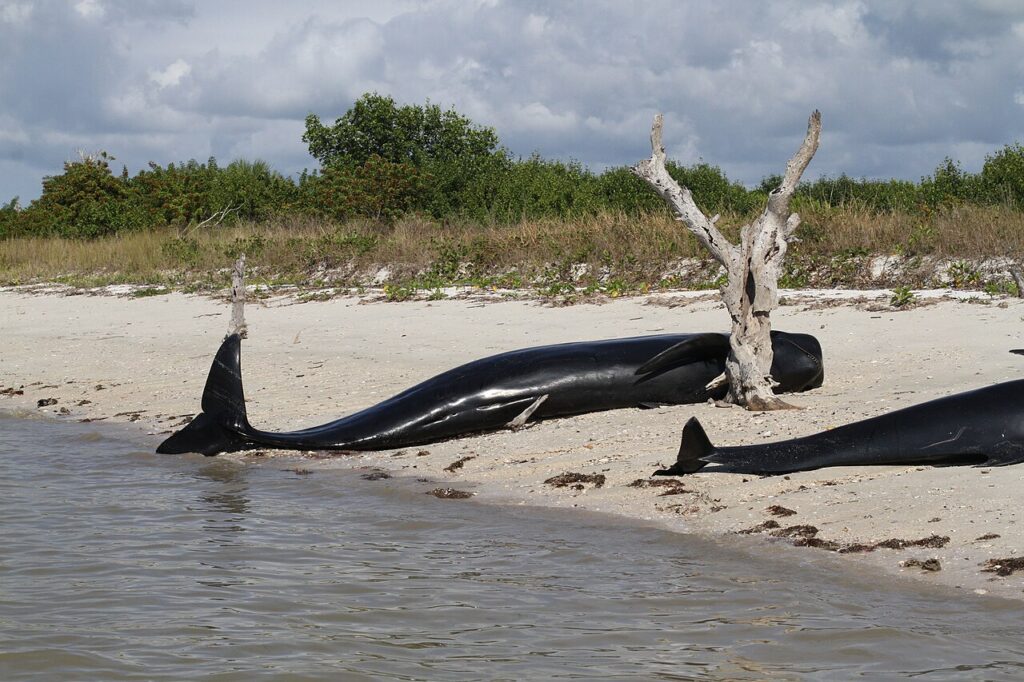


Dozens of pilot whales have been found stranded on a beach on New Zealand’s North Island, and rescuers have been working to refloat the survivors, the country’s conservation department said on Thursday, 5 November 2026. The stranding, at Ngawi on the coast near Cape Palliser, is one of the largest in New Zealand in recent years. By Friday, 6 November 2026, the Department of Conservation said 43 whales had died, and none was believed to have survived.
The Department of Conservation initially said at least 20 pilot whales were stranded along the Ngawi coast near Cape Palliser, the southernmost point of the North Island. Local reports put the number higher, with Radio New Zealand reporting that locals said up to 50 whales had been stranded on the coastline overnight. The updated official picture, reported on 6 November 2026, was grimmer: Project Jonah estimated 40 to 50 whales had stranded along several kilometres of coastline, 43 of them had died, and rescuers said there was no reason to believe any had survived.
A race against the tide
The department said it was working with local iwi — a Maori tribe — and Project Jonah, a group that specialises in rescuing stranded whales. Early reports spoke of two whales refloated and four still alive, with rescuers planning to try to refloat them during high tide, but the refloat attempts were largely unsuccessful. The stranding was in a remote and rocky area, with surf making the rescue work difficult, and the whales found alive succumbed through the day.
Rescuers had worked to keep the surviving whales hydrated and stable while they waited for the water to rise high enough to float them back out to sea. Pilot whales are social animals that travel in pods, and when one strands, others often follow — which is why a single stranding can quickly become dozens of animals on a beach at once.
Why whales strand in New Zealand
Whale strandings are fairly common in New Zealand and neighbouring Australia, owing to large populations of long-finned pilot whales living in the deep oceans surrounding both island nations. The cause of whale strandings is unknown, and experts have yet to fully explain why whole pods come ashore together.
New Zealand’s long, gently sloping beaches are thought to play a part, confusing the whales’ navigation as they follow the coastline. Once a whale is on the sand, its own weight can crush its organs, and the sun and wind can dry its skin quickly — which is why rescuers pour water over stranded whales and cover them with wet sheets while they wait for the tide.
A community effort
The rescue at Ngawi was a community effort from the start, with locals, iwi members, conservation staff and Project Jonah volunteers working side by side. The operation continued through the day, with the aim of returning as many of the surviving whales as possible to the open sea when the tide allowed.
Not every whale in a mass stranding can be saved, and at Ngawi, despite the efforts of everyone who turned out, none survived. The dead whales were to be buried with the support of local iwi. But the two that were reported refloated early on, and the four still alive and being cared for at first, are the reason rescuers keep turning up, tide after tide, for animals that cannot save themselves.