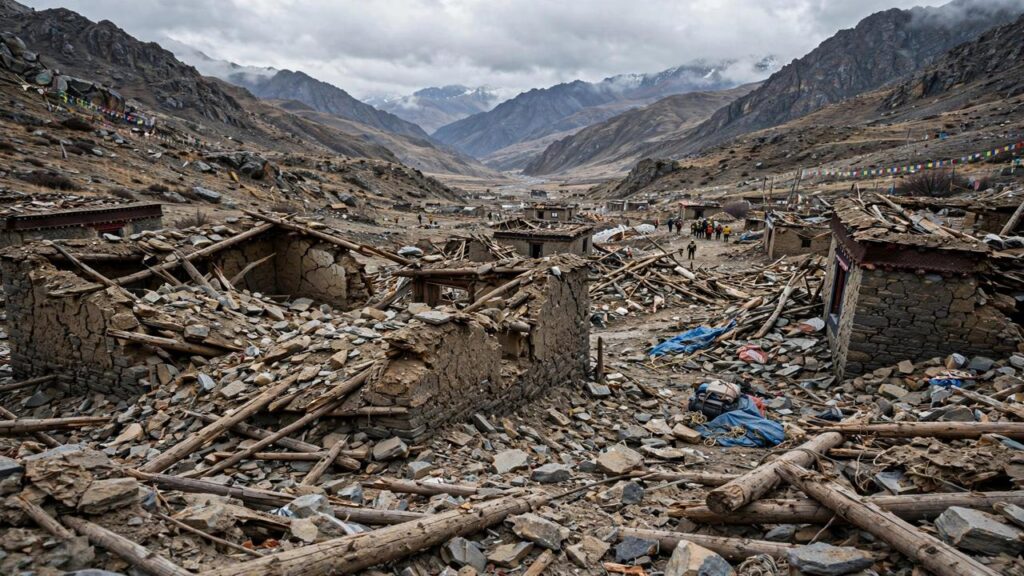

A magnitude 7 earthquake struck China’s southwestern region of Tibet on Thursday night, 22 October 2026, killing 16 people and injuring dozens more, according to state news agency Xinhua and Reuters. The Tibet earthquake is the strongest to hit China since January 2024, officials said.
The quake struck at around 10:33 p.m. local time, with its epicentre in Nagqu, a high-altitude city in northern Tibet, according to the China Earthquake Networks Center. The epicentre was in a sparsely populated county about 400 kilometres from the Tibetan capital, Lhasa.
Homes cracked and residents fled outside
According to Xinhua, citing Nagqu City’s emergency management bureau, 32 people were initially injured, with 11 in serious condition and 21 with minor injuries in the first hours. Local authorities found at least two injured people in a village near the epicentre.
Videos released by local official media showed people leaving their homes and seeking shelter outside or in cars parked on the street, officials said. One resident reported being awakened by the strong quake and hearing the house squeaking during the tremor.
Some houses in villages closest to the epicentre showed cracks, the state broadcaster said. The average elevation within five kilometres of the epicentre is about 4,864 metres, according to China Earthquake Networks Center data.
Rescue teams head to the epicentre
Local fire and rescue teams mobilised and headed to the affected region, state media reported. A string of smaller tremors of around magnitude 3 and 4 were recorded in surrounding regions after the main quake, officials said.
Officials said the quake was clearly felt in the local area, although its remote, sparsely populated location limited the number of people directly exposed. The depth was reported at 10 kilometres by Chinese authorities.
The death toll recalled the scale of past disasters in the region, officials noted, including a magnitude 7.1 tremor in Yushu in neighbouring Qinghai province in 2010 that killed at least 2,698 people.
Emergency officials said damage assessments would continue village by village in the coming days, with priority given to schools, clinics and homes near the epicentre, and they urged residents to sleep outside damaged structures until engineers confirmed buildings were safe to re-enter after aftershocks.